Below is a news release from the Idaho Department of Fish and Game.
Idaho Fish and Game is proposing a combination of translocation and lethal removal of about 100 nonmigratory elk on private land west of Emmett during spring and summer of 2026. The goal is to reduce damages on agricultural land, which last year exceeded $1 million in this area.
Fish and Game will target elk that are living year-round on private land owned by five owners. The year-round herd has grown to 350 animals over the last five years despite efforts by hunters, landowners and Fish and Game staff to reduce elk numbers and associated crop damages.
Although the elk caused agriculture damage that exceeded $1 million, landowners were only reimbursed for about 35% of their reported losses. The shortfall was due to two claims exceeding the single-claim payment maximum of $125,000 in state law, and overall, statewide claims last year exceeded Fish and Game’s fund for depredation payments, which resulted in proration of claims. See more about Idaho’s depredation laws.
Targeting the year-round elk
Fish and Game has trapped and fitted GPS collars on several elk from this herd and found they remain on private property year-round (outlined below in pink, blue, green and purple). 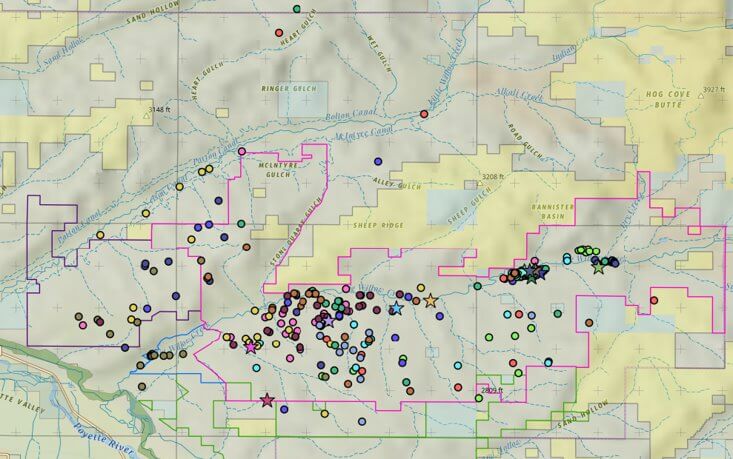 Each colored dot and star represents a different radio-collared elk. Stars show summer capture sites, and dots are the locations of collared animals throughout fall and early winter.
The Weiser Elk Zone, which Unit 32 is part of, is currently above Fish and Game’s population objectives for elk, and also home to large migratory herds that often winter on these properties. The project will occur during spring and summer to ensure resident elk are translocated or removed, instead of the about 1,000 migratory elk that winter in the area.
Fish and Game officials are proposing to relocate about 40 elk to a unit, or units, that are currently below elk objectives, but the exact number depends on the success of trapping efforts. The elk would be trapped and hauled to public lands with suitable habitat outside of Unit 32.
Previous translocation projects have shown that attempting to trap all of a large herd, or a large portion of a herd all at once, risks the safety of the elk. Experience has also shown that elk quickly learn to avoid traps, so attempting to translocate the entire 100 would likely be unsuccessful.
See a presentation to the Fish and Game Commission about the project.
Fish and Game will contract with U.S. Department of Agriculture’s Wildlife Services to lethally remove the remainder of the 100 elk that can’t be translocated, probably about 60. Those animals will be processed by a licensed meat processor, and the meat will be distributed to regional food banks.
Unintended “prime” elk habitat, but not a refuge
The resident elk herd has grown in recent years due to availability of food, however, they have not enjoyed a refuge on these properties.
Fish and Game has offered general season antlerless and antlered elk hunts in Unit 32, and landowners have allowed a substantial amount of managed public hunting. Fish and Game has also provided additional harvest opportunities through Landowner Permission Hunts, which you can learn more about here.
Last year, hunters harvested about 150 elk on these properties. However, calf production rates are high because of good nutrition, and harvest has been insufficient to reduce the year-round resident elk herd and prevent further damages.
Similar projects undertaken by Fish and Game have effectively reduced problem elk herds and agriculture damage in other parts of the state.
(Photo credit: Idaho Department of Fish and Game)