Fire is perhaps the most dynamic and relevant force shaping Western ecosystems. It can reduce cover, increasing big game’s susceptibility to certain predators, and create stressful environmental conditions. Conversely, it can improve big game habitat by stimulating new plant growth. There remains a critical gap between understanding how these changes affect big game—and how those outcomes could inform management decisions.
To address this gap, RMEF along with valued partners the U.S. Forest Service, Rocky Mountain Research Station, Colorado State University and Utah Division of Wildlife Resources are using an integrated approach. The first phase of this RMEF-backed research focuses on mule deer, while the second phase expands to elk and other ungulates. The project combines: mule deer movement data (where animals go following fire), physiological data (stress, energy use and body condition), diet and nutrition data (what do they eat), and habitat and fire data (burn severity, vegetation recovery, temperature).
By bringing these components together, this work moves beyond simply asking “Do animals use burned areas?” and instead provides the foundation to answer “Under what conditions do habitat disturbances like fire benefit or limit big game populations?” The goal is to translate these insights into practical guidance for habitat treatments, post-fire restoration and long-term conservation planning, ensuring RMEF investments deliver measurable benefits to wildlife and the landscapes they depend on.
Animal captures are planned for spring 2026, with follow-up winter recaptures in 2027 as needed. One project in progress near Nebo, Utah, is utilizing some groundbreaking technology to understand the movements of and collect data from local mule deer populations. This study integrates mule deer GPS collar data, cougar predation risk, deer diet analyses and novel bio-logging technology in mule deer (heart-rate and body-fat sensors)—tools rarely applied in free-ranging ungulates. This creative and cutting-edge research directly links fire conditions with forage quality, stress, predation risk, adult survival, and fawn and calf recruitment.
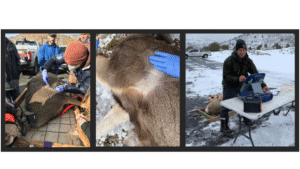 Researchers capture, collar and implant a bio-monitor in a Utah mule deer.
This work is part of RMEF’s broader research program focused on understanding how habitat changes affect elk and other big game. By investing the time, energy and funds to ensure science-based research outcomes, we are providing important data to help in optimally managing wildlife habitats to support elk, mule deer and other big game.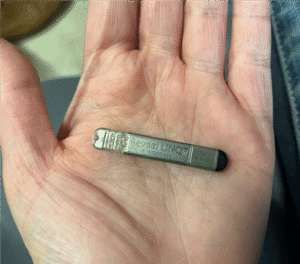
This cardiac monitor implant could revolutionize data collection techniques in ungulates and other large mammals.