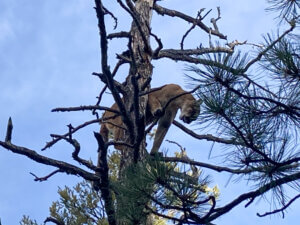
Call them what you will, wolves impact their surroundings. However you label them, the presence of wolves in areas with big cats forces their mountain lion apex predator rivals to leave meals behind but also, to entirely change their diets.
The research shows the presence of wolves impacts not only prey, but also another apex predator. The study, recently published in the journal of the National Academy of Sciences, reveals wolves force mountain lions to leave their kills and to entirely change their diets.
“When one carnivore steals a kill from another carnivore, this is a behavior that is called kleptoparasitism. So, it’s theft and it only benefits one species,” said Wes Binder, lead author of the study and Ph.D. student at Oregon State University’s College of Agricultural Sciences. “But what’s interesting about wolf and cougar interactions is that cougars are very proficient at hunting themselves. So, they don’t need to play this game of scavenging from other large carnivore kills because they can create those kill sites themselves…but wolves are very proficient at kleptoparasitism.”
Binder said since elk numbers in Yellowstone declined over the last three decades, mountain lions shifted their focus from elk to deer.
“Because deer are smaller, cougars eat them faster because it gives wolves less time to find a cougar sitting on its kill so kleptoparasitism is tied to the diet of cougars. If there’s no escape terrain nearby, then cougars run the risk of mortality from wolves in those places,” said Binder.
The study builds on decades of research showing that wolves dominate interactions because they live in packs, while cougars are solitary.
For more information on the study, including a video and photography, read the Oregon State news release.