December 2025 marks the 25th anniversary of the restoration of wild elk to their historic Tennessee Range. Getting them there was quite a challenge, and the Rocky Mountain Elk Foundation played a pivotal role in making it happen.
In the late 1990s, the Tennessee Wildlife Resources Agency (TWRA) decided to investigate restoring elk. In 2000, a newly launched study helped determine if and where elk might be brought back. Results encouraged wildlife officials to move forward.
In December of 2000, the first group of elk from Elk Island National Park in Canada was released at the Royal Blue Wildlife Management Area. RMEF supported that restoration, both financially and through the sweat and terror of the southern and then-Canadian Elk Foundation volunteers who helped bring the elk via a cross-continental convoy from Alberta to Tennessee over ice-packed highways and epic winter storms.
Below is part of a 2003 January/February Bugle magazine article titled, “5,000 Miles to Graceland.” Provo made several elk convoy trips over several years. Fourteen people from Canada and the U.S. made the trip in multiple trailer-towing vehicles. 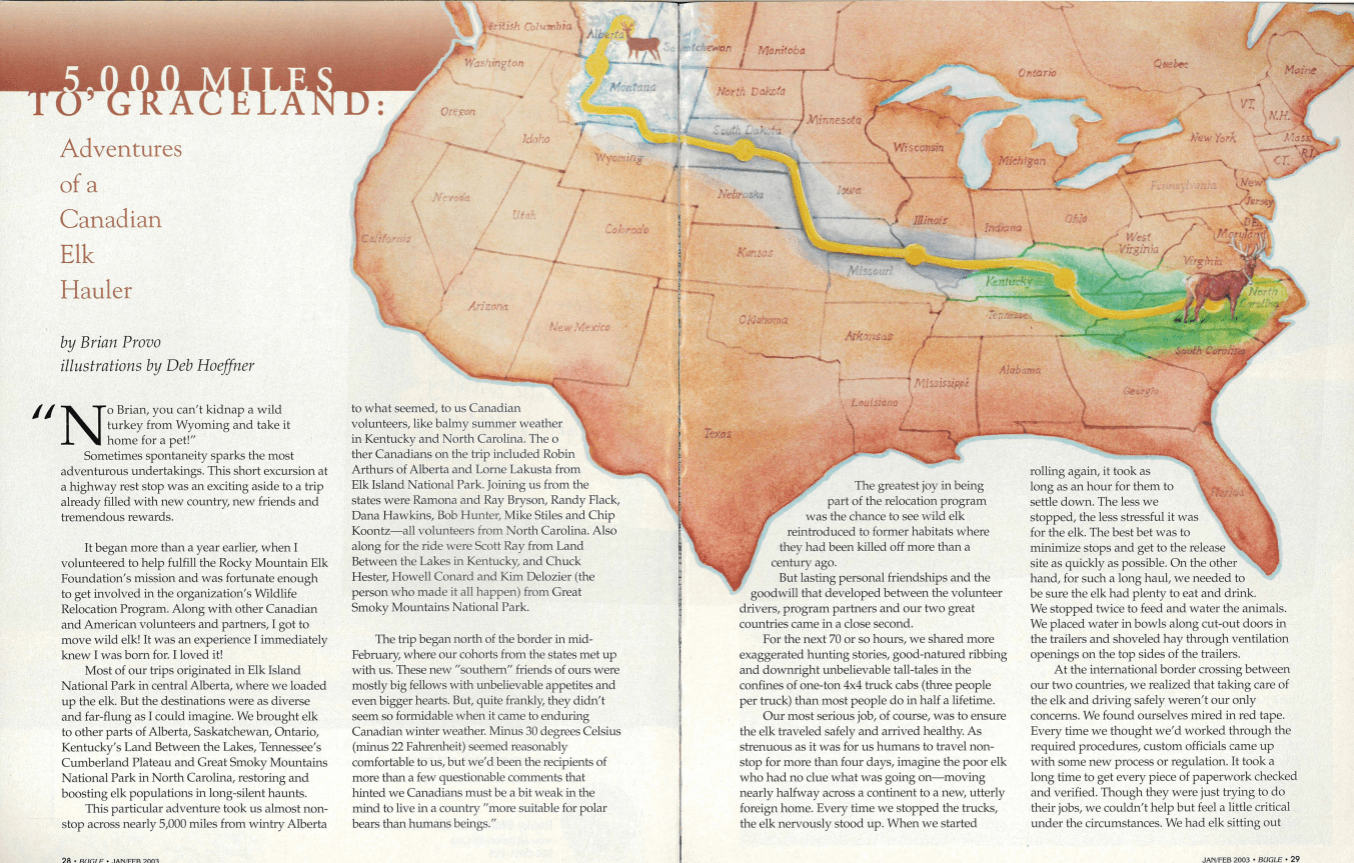 For the next 70 or so hours, we shared more exaggerated hunting stories, good-natured ribbing and downright unbelievable tall tales in the confines of one-ton 4×4 truck cabs (three people per truck) than most people do in half a lifetime. Our most serious job, of course, was to ensure the elk traveled safely and arrived healthy. As strenuous as it was for us humans to travel nonstop for more than four days, imagine the poor elk who had no clue what was going on-moving nearly halfway across a continent to a new, utterly foreign home. Every time we stopped the trucks, the elk nervously stood up. When we started rolling again, it took as long as an hour for them to settle down. The less we stopped, the less stressful it was for the elk. The best bet was to minimize stops and get to the release site as quickly as possible. On the other hand, for such a long haul, we needed to be sure the elk had plenty to eat and drink. We stopped twice to feed and water the animals. We placed water in bowls along cut-out doors in the trailers and shoveled hay through ventilation openings on the top sides of the trailers.
At the international border crossing between our two countries, we realized that taking care of the elk and driving safely weren’t our only concerns. We found ourselves mired in red tape. Every time we thought we’d worked through the required procedures, custom officials came up with some new process or regulation. It took a long time to get every piece of paperwork checked and verified. Though they were just trying to do their jobs, we couldn’t help but feel a little critical under the circumstances. We had elk sitting out there in below-zero temperatures. By the end of the process, we all pretty much agreed there were a few of those border officials who were born without a sense of humor.
Finally, we were on our way again, running smoothly through Montana, Wyoming, South Dakota.
When we hit Iowa, the snow was gone. Then Missouri and, uh-oh, St. Louis at rush hour! That great big arch would have been lots more impressive if we could’ve taken our eyes off the countless vehicles cutting just inches in front of our bumpers at 70 miles per hour. An hour or so later and with white knuckles and our fingerprints forever embedded in the steering wheels of our trucks, we were through it. Relaxed again, the hours and miles continued to speed past, and before we knew it, the grass was getting green.
Illinois, Kentucky, and then we arrived at our first release destination: Land Between the Lakes. We left about a third (17) of our 50 elk in their new home, and then we were on the road again. Tennessee – home of the Grand Ole Opry!
As lovers of wildlife, we shared the spectators ‘ thrill, along with a great sense of relief that all of our passengers had traveled well and arrived apparently healthy. After so much effort and so many miles, it was great to see them all looking good. With heartfelt goodbyes and serious commitments to stay in touch with our many new friends, we Canadian volunteer drivers started up our trucks and headed home.”
Dating back to 1990, RMEF and its partners completed 120 conservation and hunting heritage outreach projects in Tennessee with a combined value of more than $4.7 million. These projects conserved or enhanced 79,699 acres of habitat and opened or improved public access to 78,388 acres.
(Photo credit: Rocky Mountain Elk Foundation)