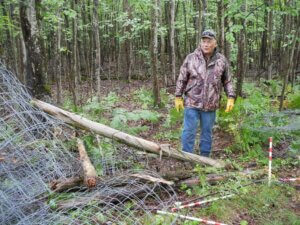
In the Pigeon River Country State Forest of northern Michigan, volunteers from RMEF and the Michigan United Conservation Club (MUCC) helped remove exclosures from a completed 40-year-old research project. The fencing was constructed in the 1980s by the Michigan Department of Natural Resources (DNR) along with a Michigan State graduate student to study the effects of browsing by elk and white-tailed deer on regenerating aspen. Now that the study has concluded, removing the fencing opens access to these important areas for not only elk and deer, but black bears and wild turkeys, too.
The Pigeon River Country State Forest is important country for Michigan’s roughly 1,200 elk, with a large chunk of the herd residing in the 109,000-acre “Big Wild” as locals call it. It is the largest section of undeveloped land in Michigan’s Lower Peninsula.
Roughly 50 volunteers removed six exclosures, each measuring 64 feet by 64 feet and about 8 feet tall. All told, volunteers removed about a half mile of fencing, according to Miranda VanCleave, a wildlife technician with the DNR who helped direct the project.
But the task wasn’t as simple as just pulling posts and rolling wire. An ice storm earlier in the year had decimated parts of the forest. With no road access to the exclosures, volunteers had to walk into most of the sites. Weather conditions weren’t too favorable for a work party, either.
“It just absolutely downpoured, and we still knocked it out,” VanCleave said.
Dameon Metzger, RMEF’s Michigan regional director, noted the rain had little effect on the attitude of the volunteers.
“Everyone was in high spirits,” he said, “even though it was a cold, rainy day.”
About half of the volunteers were MUCC volunteers and the other half were RMEF volunteers attending the annual Michigan RMEF Rendezvous, including volunteers from seven chapters from across the state. The event allows time for volunteers to swap banquet fundraising ideas and brainstorm ways to put more money on the ground for wildlife, according to Mark Thomson, Thunder Bay chapter chair. The rendezvous is one of his favorite events.
“When working on the rendezvous it feels like we are doing something, not just for our elk herd but all the critters locally,” Thomson said.
He’s attended the event for years and knows the impact it can have for the DNR.
“They can really take advantage of the extra manpower,” Thomson said. “Every year we are begging, ‘let’s do more.’”
The study included 18 total exclosures. Two were kept intact for educational purposes, and the rest will likely be removed by volunteer work parties at future events.
“There is a lot we wouldn’t be able to do without RMEF’s and MUCC’s help,” VanCleave said.
RMEF has been active in the Pigeon River Country State Forest area for years, completing nearly 40 land conservation, access, and habitat and wildlife stewardship projects. In December 2025, RMEF contributed funding for a land acquisition by the DNR that added 8,850 acres to the Pigeon River Country State Forest.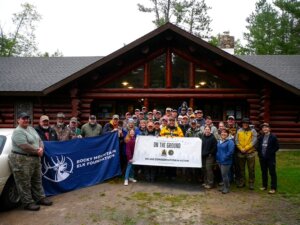
About the Rocky Mountain Elk Foundation
Now in its fifth decade of Conserving America’s Big Game,™ RMEF will extend its impact on habitat and public land access to 10 million acres by 2030. RMEF conserves and enhances habitat for elk and all big game, opens and improves access for hunting and other outdoor recreation, conducts science-based wildlife research and ensures the future of our hunting heritage through advocacy, outreach and education. Members, volunteers and supporters nationwide help RMEF further its mission. Find out more and join the movement at rmef.org or 800-CALL-ELK.