Trail cameras earned their reputation in the whitetail woods, where a hunter can hang a camera over a scrape, drive back four days later, and pull a card. Elk country does not work that way.
Out west you are covering drainages, wallows, springs, and saddles instead of funnels and field edges, working country measured in square miles instead of acres. The camera you hang in July might not get checked until September, and getting to it could mean a full day on foot. Weather at 9,000 feet does things to gear that a Midwest bean field never will.
The result is that the features that matter most in elk country are not always the ones that get the most attention on the box. Here is what actually matters when you are picking a camera for big country, and which Stealth Cam models hold up.
Big Country, Long Gaps
The single biggest difference in western camera work is how rarely you get back to your cameras. In whitetail country a weekly check is normal. In elk country, a camera might sit untouched for six weeks or the entire summer.
That changes the math on everything. Battery life stops being a convenience and becomes the whole ballgame. So does storage. A camera that fills its card in three weeks is a camera that missed the last month of the summer pattern.
If you are running cellular, transmission is where a lot of your battery goes. Every image the camera sends costs you power, and a camera firing on wind-blown branches all afternoon spends that power on nothing. On Stealth Cam’s latest cellular models, Command AI features like False Image Detection cut down what gets sent, which stretches runtime and keeps your feed in the Command app clean enough to actually read. You are not wasting uploads and battery on images that do not matter.
Power Is the Whole Game
Everything about western camera work comes back to how long the camera runs without you.
A camera on internal batteries in cold country is on a clock, and that clock runs faster than most hunters expect. Lithium AAs help. So does keeping the camera from burning power on nothing. But if the camera has to survive July through September on its own, internal batteries alone are a gamble.
Solar battery packs from Stealth Cam are the simple answer. With the panel and battery working together in one setup, the camera can keep charging itself through the summer. Where sunlight is limited by canopy, terrain, or a north-facing slope, external battery packs from Stealth Cam give you the extra runway.
On a camera you cannot easily reach, that is not an upgrade. That is the difference between having intel in September and having a dead camera on a tree.
If you are hanging cameras deep, plan the power before you plan the placement. You cannot afford to lose power when it counts.
Storage Is the Other Half
The second way a camera fails you quietly is by filling up.
A full card is worse than a dead battery in one respect. The camera looks fine when you walk up to it. It has just been sitting there recording nothing since the second week of August.
Match the card to the camera and the settings to how long the camera has to sit. Cameras shooting 32MP stills and 4K video eat storage fast, and on those you want the largest card the camera supports. There is no good reason to run a set-and-forget camera on a small card. On models with a lower card ceiling, dial your video resolution and burst settings to match the soak time you are asking for.
Check the spec on your specific camera before you buy the card. Not every model reads the same capacity.
Coverage in Open Terrain
Whitetail hunters place cameras on pinch points because whitetails use pinch points. Elk do not always cooperate. A wallow, a spring, a saddle, or a bench can see traffic from any direction, and a camera locked into a single narrow field of view can watch a bull walk past just outside the frame.
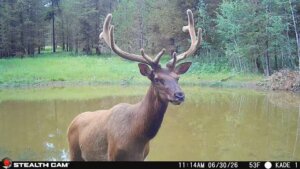
This is the strongest argument for wider coverage in the West. The Stealth Cam Revolver Pro 3.0 was built for exactly this problem. It gives you full 360-degree detection and imaging in one unit, which makes it a natural fit for open parks, water sources, and wallows where animals can come from anywhere. For a hunter who can only make a limited number of trips, one camera covering more approach angles changes how much ground you can realistically cover.
Staying Invisible
Public land elk country means your cameras are not the only thing out there. Other hunters, hikers, and predators all move through the same country, and a camera throwing visible light at night announces itself to every one of them.
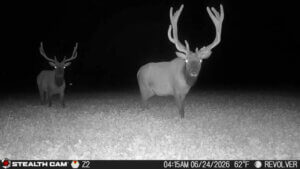
The Stealth Cam Deceptor Max 3.0 runs no-glo, which means it stays dark and stays unnoticed. Game does not spook off it, predators do not investigate it, and anyone walking past in the dark has no reason to look twice. On heavily hunted public ground, that matters as much for keeping your camera as it does for keeping your intel.
When You Want the Footage
Every camera in the Stealth Cam 3.0 lineup puts out excellent image quality. The Stealth Cam Revolver Pro 3.0 and Stealth Cam Deceptor Max 3.0 both deliver. But sometimes you want the footage.
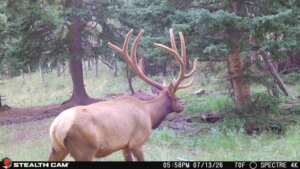
The Stealth Cam Spectre 4K Pro is the dual lens, 4K option in the lineup. Set it on a wallow or a spring you already believe in and it captures the kind of footage worth keeping long after the season closes.
Cellular or Not
There is a practical side to it and a regulation side to it.
Practically, cellular cameras solve one of the biggest challenges in western camera work. If the camera is sending you images, you are not burning a day hiking in to pull a card, and you are not putting human scent and pressure into country you plan to hunt.
Trail camera rules vary depending on where and when you hunt, and they can change from year to year. Check the current regulations where you are hunting before you hang a camera.
Where cellular is restricted, or where you simply prefer to run without it, two Stealth Cam models cover the ground.
The Stealth Cam DS4K Ultimate is the one to run when you want the best image quality without the cellular. A 32MP native sensor, 4K video at 30 FPS, 100 feet of detection and IR range, and a 0.2-second trigger speed. It catches fast-moving game and the images come back sharp. Support for 128GB cards and a 12V jack make it a legitimate set-and-forget option for a long soak.
The Stealth Cam GMAX Vision is the stealth play at a lower price point. It runs 42 no-glo 940nm LEDs, so it works in the dark without announcing itself to game, predators, or anyone else walking the same trail. You get 32MP stills, 1080p video, 80 feet of detection range, and a 2.4-inch color screen so you can check captures on the mountain without hauling a card reader.
Both include integrated Python cable provisions, which matters more on public ground than most people account for until a camera goes missing.
Building the Setup
Every camera you hang needs to earn its spot.
A reasonable approach for a unit you are learning: a Stealth Cam Revolver Pro 3.0 on your best water source or wallow to catch traffic from any direction, a Stealth Cam Deceptor Max 3.0 on a trail or bench where you want to stay invisible, and a Stealth Cam Spectre 4K Pro where you want the 4K footage worth saving.
Hang them early, hang them well, and let them work. In elk country, the camera you set in July is the one that tells you where to start in September.
Learn more at www.stealthcam.com.
 |
 |
 |